Past, present and future: monolithic vs. microservices architecture
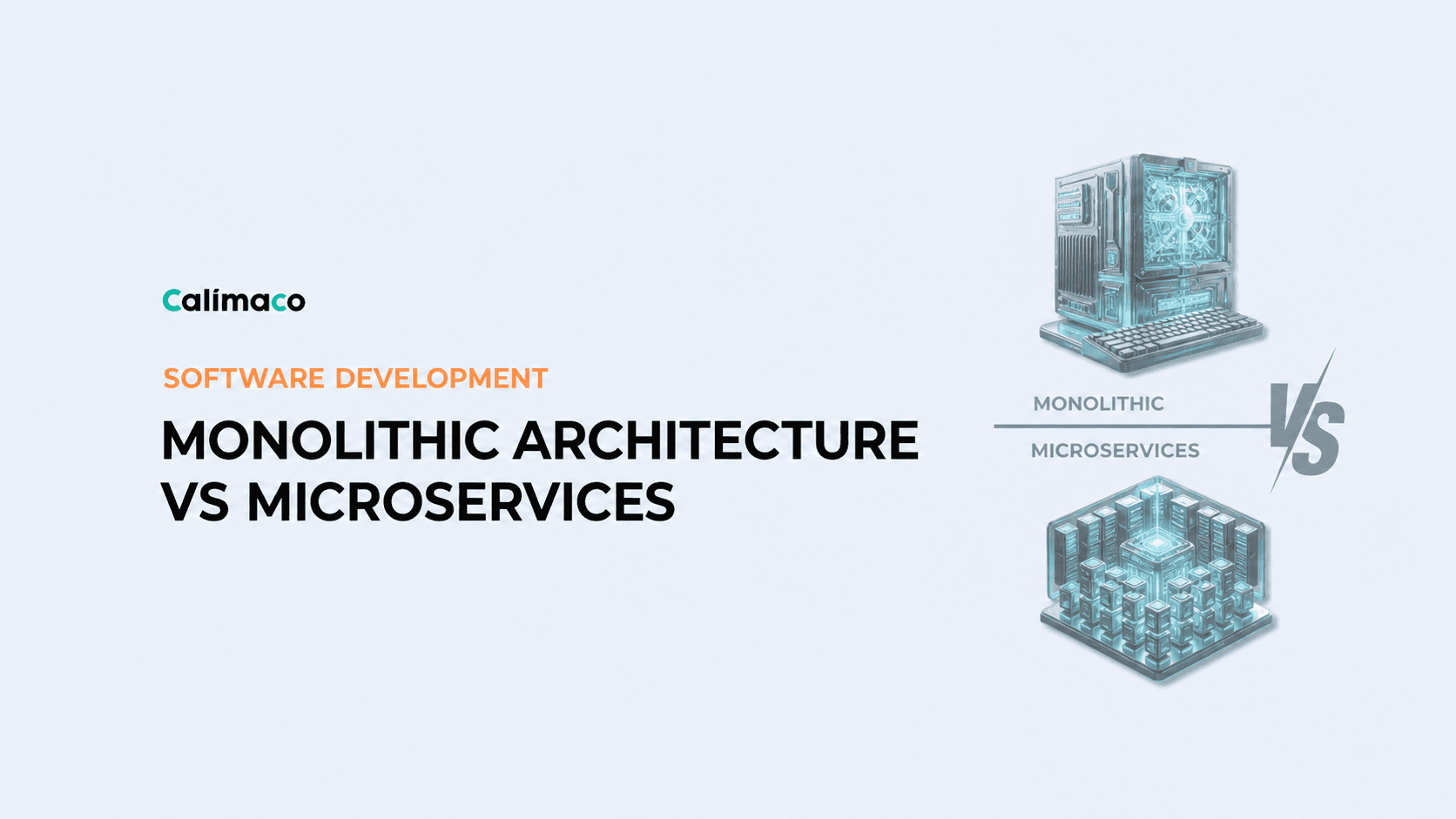
In 2009, Netflix ran into major growth problems: its monolithic infrastructure couldn't keep up with the exponential rise in user demand. So they decided to migrate their platform to a microservices architecture, becoming one of the first high-profile companies to do it successfully on the cloud.
Today, Netflix runs more than a thousand microservices that manage and support separate parts of the platform, and is responsible for roughly 15% of global Internet traffic.
Basic differences between the two architectures
Monolithic architecture
A software build constructed in a single block: all the components are interconnected and deployed as one entity. All processes run as a single service.\ Consequence: if demand goes up, the whole application has to scale, which limits experimentation and makes it harder to roll out new ideas.
Microservices architecture
The software is made up of independent services, each with a single function, communicating through well-defined interfaces.\ Advantage: each service can be updated, modified or scaled in isolation according to demand.
Market data: according to Mordor Intelligence, the cloud microservices market will grow from USD 1.3 billion in 2023 to USD 3.72 billion in 2028, with a CAGR of 22.8%.
Capacity for innovation
A microservices architecture makes it easier to roll out new ideas quickly: if one component fails, the rest of the system keeps running. That's critical in online casinos, where downtime means lost revenue and trust.
Process agility
Microservices encourage small, autonomous teams that own each service, which shortens development cycles.\ Example: if there's a problem with a game provider, in a monolith the whole system would be affected; with microservices, it's fixed in isolation and fast.
Security considerations
- Smaller attack surface: a security flaw doesn't compromise the whole system.
- Specific protocols: stricter controls can be applied to critical services (e.g., financial transactions).
- Principle of least privilege: each service operates with the minimum level required, limiting the reach of a potential attacker.
Summary
| Aspect | Monolithic | Microservices | | --------------------- | ----------------------------------- | ------------------------------------- | | Deployment | A single unit | Independent services | | Scaling | Scales the entire system | Scales only the service needed | | Innovation | Limited; high risk on failures | Agile; isolated failures | | Development time | Long cycles | Short cycles | | Security | Greater impact from vulnerabilities | Smaller surface; minimum privileges |
Adopting microservices can drive innovation, agility and security compared to a monolithic approach, positioning your platform better for the future.
More notes from the team.
 Technology
ChatGPT in casinos: the online gaming revolution
April 14, 2026 Technology
Multi-Wallet: when the platform adapts to the player's economic reality
Multi-Wallet adapts the platform to bi-currency economies, allowing players to use multiple currencies with a single account and separate wallets.
March 18, 2026 Technology
AI and casinos: an alliance already in motion
March 16, 2026